A Personal Interest Menu for an Unplanned Afternoon
A personal interest menu helps you choose an enjoyable activity for an unplanned afternoon, with clear starting points that suit your mood and circumstances.
The common mistake with an unexpected free afternoon is asking, “What should I do?” while standing in the kitchen with no idea where to begin. That open-ended question can turn a welcome stretch of time into restless scrolling or a list of chores. A personal interest menu makes the first choice smaller: pick something appealing, then follow a clear first action.
Imagine that Margaret, a fictional retiree, has finished lunch when an appointment is cancelled. She has an afternoon free, feels a little flat and does not want to make plans with anyone. Her menu is not a schedule or a demand to be productive; it is a set of ready-to-start activities she has already considered.
Why can free time be hard to use?
Margaret enjoys gardening, music, sketching and seeing friends. Yet when time opened up, she would think of every possibility at once. Gardening seemed to require energy, drawing needed preparation, and a phone call felt like a commitment. She often ended up doing nothing she had actively chosen.
The difficulty was not a lack of interests. It was the gap between having an idea and being ready to begin. “Do some gardening” was vague; “sit by the back door and sort the seed packets” made the first move clear. That difference shaped her menu.
How can you choose activities that genuinely appeal?
Margaret started with things she liked, rather than hobbies she thought she ought to pursue. For each activity, she considered whether it suited a brief opening or a more settled spell, and whether she would enjoy it when feeling quiet or alert. Those labels helped her choose; they were not a timetable to follow.
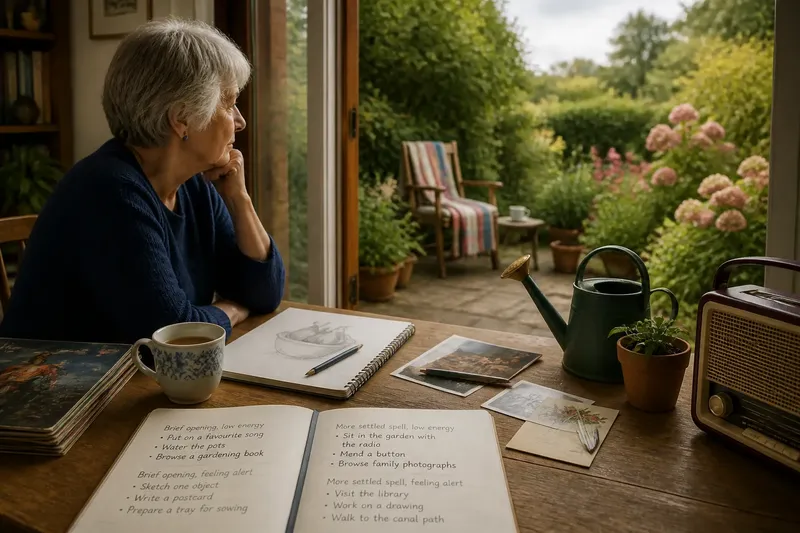
- Brief opening, low energy: put on a favourite song, water the pots by the kitchen door, or browse a gardening book.
- Brief opening, feeling alert: sketch one object on the table, write a postcard, or prepare a small tray for sowing seeds.
- More settled spell, low energy: sit in the garden with a radio programme, mend a button while listening to music, or browse family photographs.
- More settled spell, feeling alert: visit the local library, work on a drawing, or walk to the canal path if it feels comfortable.
Activities need not fit neatly into one group. Margaret could listen to music for a few minutes or let an album play while she rested. She wrote down the version that made starting easiest: “put on one side of a record” was more inviting than “enjoy music”.
What turns an idea into a ready-to-start choice?
For each entry, Margaret added a practical cue. If an activity needed an object, she named it: sketchbook and pencil, watering can, postcard and pen. If it meant going somewhere, she named the destination. That way, she did not pick an appealing idea only to discover she first had to hunt for supplies.
She kept the wording open-ended, too. “Draw a few lines” did not require finishing a picture. “Walk to the library if the weather feels comfortable” left room to change plans. An activity should offer a beginning, not a test of whether the afternoon was well spent.
One entry read, “Make tea, take the sketchbook to the sunny chair, and draw the pear bowl.” It named a familiar place, a manageable subject and a first action. Margaret could stop after a few lines or continue if she became absorbed.
How did the menu help when plans changed?
Back in the kitchen, Margaret realised she had little energy but was not unhappy. She did not want company or an outing. She chose an activity that suited a quieter mood: making tea and sitting in the garden with her radio and a cushion.
After a while, she noticed dry leaves and removed a few. When she tired of the garden, she went indoors and put on an album. The menu had not prescribed a sequence; it helped her make one choice, and she remained free to change it.
The useful result was not filling every moment. Margaret had chosen activities that suited her rather than waiting for the perfect idea. Her menu gave her a place to begin while leaving the afternoon hers.
How can you keep the menu personal?
Margaret later read through the entries and noticed which still sounded appealing and which felt like obligations. She removed “sort the whole craft cupboard”, a chore disguised as a pastime, and kept “choose one photograph to frame”, which still interested her.
A menu can hold quiet, creative, social and outdoor activities without implying that you must balance them. If an interest becomes less accessible or enjoyable, adapt it: listen to a concert recording instead of attending one, or ask a friend to join you for a walk. The menu should reflect what you enjoy now, not an ideal version of how free time ought to look.
It is not worth the effort to make a beautiful chart, colour-code every activity or predict every mood. A plain notebook page, index cards or a phone note will do; the useful part is the choice and its clear starting point.
What questions come up when making a personal interest menu?
How many activities should go on the menu?
Begin with a small selection of activities you genuinely enjoy, enough to offer a choice without making the page feel like another project. Add options as they occur to you, and remove anything that no longer appeals.
Should activities be organised by exact time?
No exact timings are needed. Labels such as “brief opening” and “more settled spell” can help you choose without turning an interest into an appointment.
What if an activity needs supplies or preparation?
Name the first practical cue, such as “put the knitting bag beside the chair” or “check the library opening hours”. If that preparation does not suit the moment, choose something else without treating it as a failure.
Can the menu include social activities?
Yes, if they suit how you like to connect. You might write “send a voice message to Sam” or “invite Jo for a cup of tea”, while recognising that another person may not be free.
When should you revise your personal interest menu?
Margaret kept her page somewhere easy to find and changed it when her interests or circumstances shifted. A menu is most useful when it reflects the present, rather than an old version of what you used to enjoy. A favourite activity may need a smaller starting point, a different setting or another person’s company.
A personal interest menu is a friendly prompt, not a promise to make every free hour count. When an unplanned afternoon appears, choose an option that suits your mood and circumstances, then follow its first clear action. That small decision can make the time feel more like your own.